


When we hear the phrase "Navy SEAL," the image that springs to mind is the ultimate warrior possessing relentless physical and mental resilience. But what does it actually take to become a SEAL, and what does their training regimen entail?
The Navy SEAL course is engineered to forge ordinary individuals into "Frogmen"warriors capable of enduring conditions far beyond normal human limits. Whether you dream of joining the SEALs or are simply fascinated by a program that transforms everyday people into elite operators, this article breaks down everything you need to know.
What are the Navy SEALs?
SEAL stands for Sea, Air, and Land, officially designated in Thailand as the Underwater Demolition Assault Unit under the Naval Special Warfare Command. Renowned for its arduous training duration, this course is widely recognized as the toughest military training program in Thailand. Operating under the Royal Thai Navy, SEALs are trained to execute missions across all three domains: maritime, land, and airborne operations.

Graduates who complete the training are awarded the prestigious SEAL Insignia, which carries deep symbolic meaning:
- The Thai Flag on an Anchor (Center): Symbolizes a willingness to lay down one's life to protect the Nation, Religion, and the Thai Monarchy.
- The Anchor (Background): Represents the Royal Thai Navy. While originally exclusive to naval personnel, the training is now open to qualified candidates from the Army, Air Force, and Police force as well.
- Sharks (Left and Right): Represent ferocity, awe, dignity, and strength—embodying the apex predator of the sea.
- Ocean Waves (Left and Right): Represent the constant danger and unpredictability of the open sea. The swirling waves denote obstacles, yet the shark remains undaunted, swimming effortlessly through fierce currents.
Eligibility and Training Location
Historically, SEAL training was restricted to Royal Thai Navy personnel. However, due to low annual graduation rates, eligibility expanded to include candidates from the Royal Thai Army, Royal Thai Air Force, and Royal Thai Police, provided they have consent from their home units. Applicants must be commissioned or non-commissioned officers.
Official recruitment announcements are published annually by the Royal Thai Navy. All training takes place exclusively at the Naval Special Warfare Command (Sattahip, Chonburi - Phra Island).

The Frogman Training Program
SEALs are nicknamed "Frogmen" because their training is significantly more demanding than standard military courses, requiring mastery across land, air, and aquatic environments—much like a frog that adapts to any element.
Only about 10% of applicants successfully graduate. The course spans roughly 7 to 8 months (30 to 34 weeks), making it the longest military training course in Thailand. Rather than traditional instruction, the course operates as a rigorous selection process designed to identify individuals with the physical and mental stamina suited for special operations.
The training is divided into 5 distinct phases:
- Basic Indoctrination (Approx. 3 weeks): Focuses on instilling absolute military discipline and pushing physical endurance past conventional limits.
- Core Physical & Mental Conditioning (6 weeks): Tests sheer stamina and psychological grit. Physical conditioning includes long-distance open-ocean swimming through heavy surf, carrying heavy logs, and hauling rubber boats. Mental conditioning involves high-pressure command scenarios and intense disciplinary corrections.
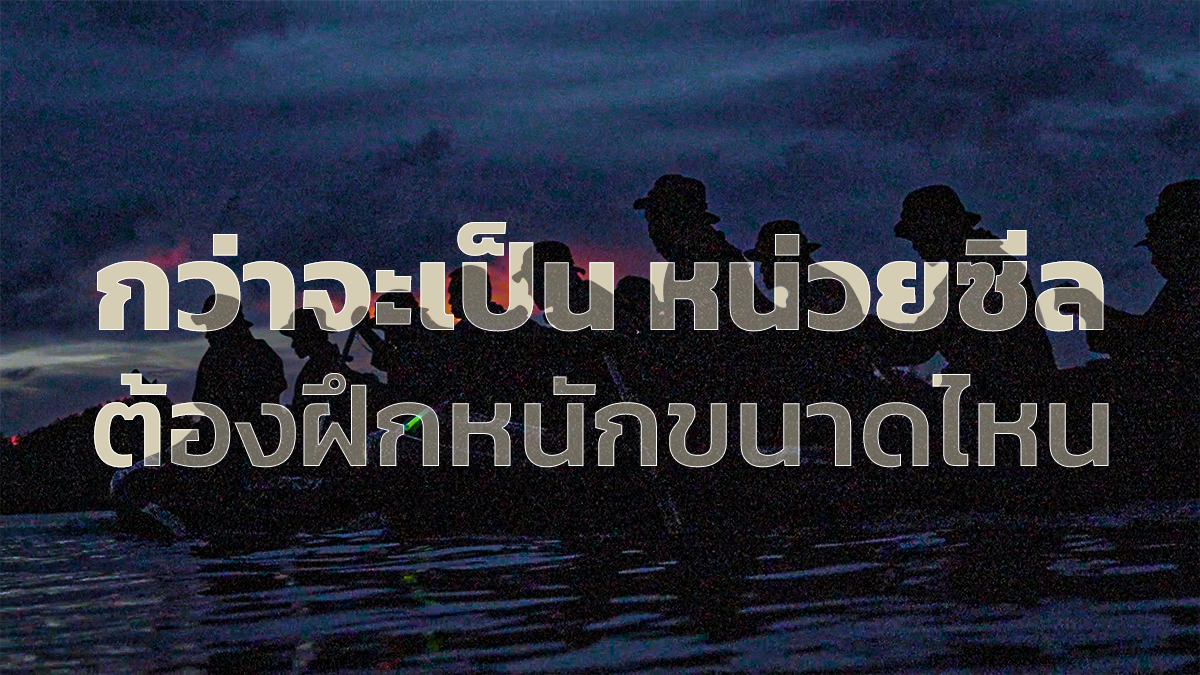
- Hell Week (120 Hours Continuous Training): The infamous "Hell Week" subjects candidates to 5 consecutive days (120 hours) of continuous physical and mental strain without real rest. Candidates undergo 24/7 exercises on land and in water—dragging heavy rubber inflatable boats across sand beaches, paddling across islands, and operating under total physical exhaustion to prove they possess the true "heart of a SEAL."
- Tactical Skills Training (Land, Sea, Air):Land: Demolitions, explosives, and jungle warfare operations.Sea: Tactical diving, maritime operations, and both open-circuit and closed-circuit rebreather diving.Air: Parachuting techniques for airborne tactical insertion into enemy territory.
- Applied Tactical Stress Scenarios (Approx. 2 months): The final phase simulates real-world mission environments. Trainees undergo survival challenges—such as being left stranded on an island for 2 days to forage for food and navigate unfamiliar terrain under extreme stress—ensuring peak operational readiness before deployment.

Tactical Gear for SEAL Training
SEAL training encompasses far more than swimming, running, or marksmanship; it tests an individual's mental fortitude under relentless stress. Because the training spans land, sea, and air, selecting equipment tailored to amphibious environments is vital to prevent performance bottlenecks especially when it comes to footwear.
Footwear for amphibious training must be durable, quick-drying, agile, and fin-compatible:
- Altama Maritime Assault: Engineered specifically for tactical water operations. These boots feature front drain ports to evacuate water rapidly and are built to fit comfortably into swim fins for long-distance ocean swims. They also pass the ASTM F2913-19 slip-resistance testing standards.
- Salomon Forces Amphib Assault: Purpose-built for amphibious terrain with high-efficiency moisture management. Constructed from non-water-absorbent materials with rapid drainage ports, they dry quickly and integrate seamlessly with swim fins.
Both footwear options are well-suited for the demanding environments encountered during special operations training.
B2G Inquiries & Tactical Equipment Procurement
Government agencies and organizations interested in tactical training equipment and military supplies on a B2G (Business-to-Government) basis can explore our product catalog or contact our sales division at VALOR STRATEGIC
- Website:VALOR STRATEGIC
- Email: admin@valorstrategic.com / sales@valorstrategic.com
- Phone: 02 118 6156 (Business Hours: 9:30 AM – 5:30 PM)
Read More Articles:
- Field Gear Used in Battle: Combat Field Gear That Helps Soldiers Survive in Warfare
- Portable Hiking Water Filters: Compact and Convenient Water Filter Straws for Removing Contaminants
- Infantry vs. Cavalry: How They Differ and Their Respective Roles in Combat


