


In modern land warfare, the Main Battle Tank (MBT) remains the absolute king of the battlefield an indispensable, high-impact combat vehicle capable of operating across all terrains and extreme weather conditions. Today’s next-generation tanks have evolved beyond heavy armor and raw firepower; they now integrate Artificial Intelligence (AI), unmanned turrets, active protection systems, and network-centric warfare capabilities.
In this deep-dive article brought to you by VALOR Tactical Store, we analyze the Top 10 Main Battle Tanks of 2026, complete with specs, features, a side-by-side comparison table, and insights into which models are currently serving in the Royal Thai Army.
Deep Dive: The 10 Most Powerful Tanks in the World (2026 Edition)
10. M1A2 SEPv3 Abrams
The latest upgrade of the battle-proven American Abrams family, the M1A2 SEPv3 (System Enhancement Package version 3), resolves power distribution limits while significantly upgrading electrical and armor capabilities. It features the Israeli Trophy Active Protection System (APS) and next-generation depleted uranium composite armor, offering elite defense against improvised explosive devices (IEDs) and anti-tank guided missiles (ATGMs)—though it weighs a massive 74 tons.
- Country of Origin: United States
- Year Introduced: 2015 (Service delivery in 2020)
- Estimated Cost: $8.5M – $9.5M USD
- Main Armament: 120 mm M256 Smoothbore Gun
- Top Speed: 67 km/h (Gas Turbine Engine)
- Crew: 4

9. Type 10
Designed specifically for tactical mobility and island defense across Japan’s mountain roads and bridges, the Type 10 is noticeably lighter than typical Western tanks (~44 tons). It incorporates a quick-swap modular ceramic composite armor system and an advanced C4I networking suite.
- Country of Origin: Japan
- Year Introduced: 2012
- Estimated Cost: $9.0M – $10.0M USD
- Main Armament: 120 mm Japan Steel Works Smoothbore Gun
- Top Speed: 70 km/h (Equal speed in forward and reverse)
- Crew: 3 (Autoloader)
8. T-84 Oplot-M
Developed from the Soviet-era T-80UD, Ukraine's T-84 Oplot-M is renowned for its all-around protection suite featuring "Nozh" (Knife) and "Duplet" Explosive Reactive Armor (ERA), engineered to counter tandem-charge warheads and armor-piercing fin-stabilized discarding sabot (APFSDS) rounds. It also carries advanced panoramic sights for hunter-killer operations.
- Country of Origin: Ukraine
- Year Introduced: 2009
- Estimated Cost: $4.5M – $5.0M USD
- Main Armament: 125 mm KBA-3 Smoothbore Gun (Fires Kombat ATGMs)
- Top Speed: 70 km/h
- Crew: 3 (Autoloader)
7. Challenger 3
The primary heavyweight MBT for the British Army, the Challenger 3 upgrades the Challenger 2 hull with a completely digitized turret and NATO-standard smoothbore gun, allowing seamless ammunition sharing with allied forces.
- Country of Origin: United Kingdom (In partnership with Germany's Rheinmetall)
- Year Introduced: 2024 (Trials underway; full entry expected by 2027)
- Estimated Cost: ~$11.5M USD
- Main Armament: 120 mm Rheinmetall L55A1 Smoothbore Gun
- Top Speed: 60 km/h
- Crew: 4
6. Leclerc XLR
France's main battle tank excels in electronic architecture and rapid engagement. The XLR upgrade package integrates the SCORPION digital battlefield management system, enabling real-time data sharing with drones and infantry fighting vehicles, along with reinforced mine and RPG protection.
- Country of Origin: France
- Year Introduced: 2022 (Delivery of upgraded units)
- Estimated Cost: $10.0M – $12.0M USD
- Main Armament: 120 mm CN120-26 Smoothbore Gun
- Top Speed: 71 km/h
- Crew: 3 (Autoloader)

5. Type 99A
The flagship MBT of China's People's Liberation Army (PLA). The Type 99A pairs composite armor and ERA with a specialized Laser Active Defense System, capable of disrupting incoming missile optical sensors or blinding enemy gunners temporarily.
- Country of Origin: China
- Year Introduced: 2011
- Estimated Cost: $3.5M – $4.0M USD
- Main Armament: 125 mm ZPT-98 Smoothbore Gun
- Top Speed: 75 – 80 km/h
- Crew: 3 (Autoloader)
4. T-14 Armata
A revolutionary departure from traditional Soviet/Russian designs, the T-14 Armata features an unmanned, fully digital turret. All 3 crew members sit isolated inside an armored safety capsule in the front hull. It uses the "Afganit" Active Protection System to detect and intercept incoming anti-tank threats mid-air.
- Country of Origin: Russia
- Year Introduced: 2015
- Estimated Cost: $4.0M – $5.0M USD (Production costs adjusted for supply chain factors)
- Main Armament: 125 mm 2A82-1M Smoothbore Gun
- Top Speed: 75 – 80 km/h
- Crew: 3 (Armored Capsule + Autoloader)
3. Merkava Mk. 4 Barak
Engineered around crew survivability, the Israeli Merkava places its engine in the front to act as an additional armor barrier. The Barak variant introduces AI battlefield management and the IronVision helmet-mounted display system, allowing the commander to view 360 degrees "through" the tank armor.
- Country of Origin: Israel
- Year Introduced: 2023 (Barak Upgrade)
- Estimated Cost: $4.5M – $5.5M USD
- Main Armament: 120 mm MG253 Smoothbore Gun (Fires LAHAT missiles)
- Top Speed: 64 km/h
- Crew: 4
2. K2 Black Panther
Purpose-built for mountain warfare on the Korean peninsula, South Korea's K2 Black Panther features an hydropneumatic in-arm suspension system that allows the tank to "sit," "kneel," or "lean" to increase gun elevation/depression angles. High-rate automatic loading ensures supreme rate of fire.
- Country of Origin: South Korea
- Year Introduced: 2008 (Entered service in 2014)
- Estimated Cost: $8.5M – $9.0M USD
- Main Armament: 120 mm / 55-caliber Hyundai WIA CN08 Smoothbore Gun
- Top Speed: 70 km/h
- Crew: 3 (Autoloader)

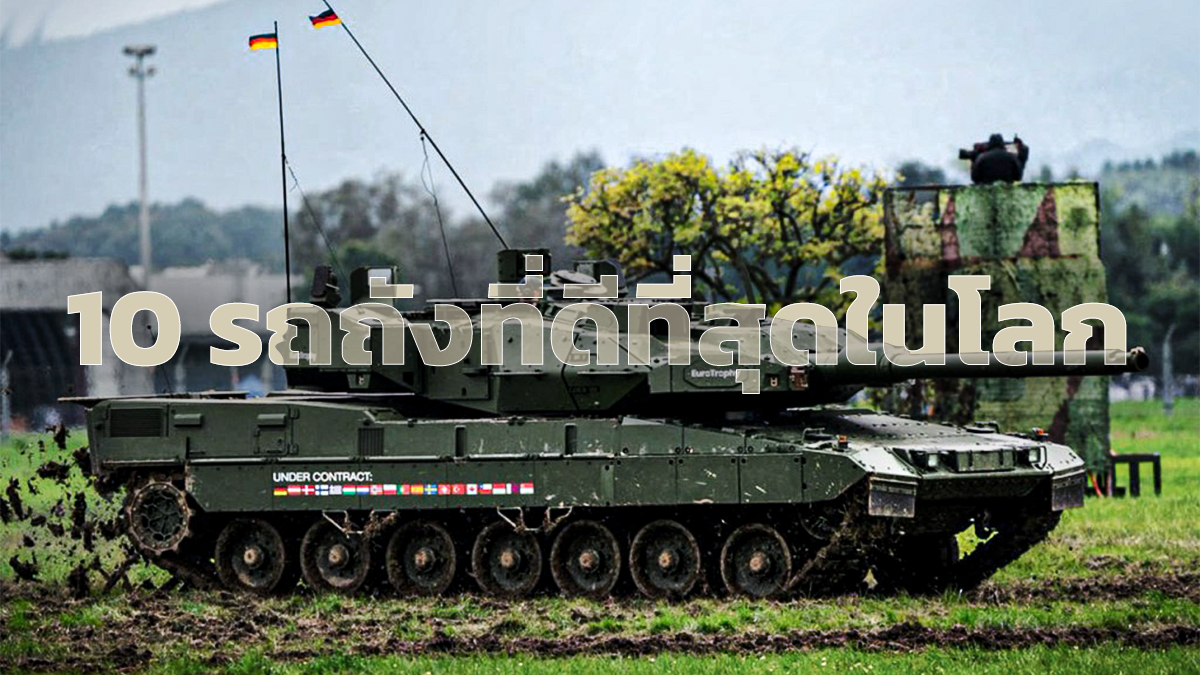
1. Leopard 2A8
Recognized worldwide as a gold standard in modern armored warfare, Germany's Leopard 2A8 upgrades overall armor density and integrates the EuroTrophy Active Protection System (APS) as a standard feature to neutralize modern top-attack drones and anti-tank missiles.
- Country of Origin: Germany
- Year Introduced: 2023
- Estimated Cost: $13.0M – $15.0M USD
- Main Armament: 120 mm Rheinmetall L55A1 Smoothbore Gun
- Top Speed: 60 – 68 km/h
- Crew: 4
Side-by-Side Comparison: Top 10 Main Battle Tanks
| Tank Model | Manufacturer | Main Gun | Max Speed | Crew |
| Leopard 2A8 | Germany | 120 mm | 68 km/h | 4 |
| K2 Black Panther | South Korea | 120 mm | 70 km/h | 3 |
| Merkava Mk. 4 Barak | Israel | 120 mm | 64 km/h | 4 |
| T-14 Armata | Russia | 125 mm | 80 km/h | 3 |
| Type 99A | China | 125 mm | 75 km/h | 3 |
| Leclerc XLR | France | 120 mm | 71 km/h | 3 |
| Challenger 3 | United Kingdom | 120 mm | 60 km/h | 4 |
| T-84 Oplot-M | Ukraine | 125 mm | 70 km/h | 3 |
| Type 10 | Japan | 120 mm | 70 km/h | 3 |
| M1A2 SEPv3 Abrams | United States | 120 mm | 68 km/h | 4 |
Did You Know? Does the Royal Thai Army Deploy Any of These Tanks?
Yes! Out of the 10 tanks listed above, the Royal Thai Army (RTA) officially operates 1 model: the T-84 Oplot-M / BM Oplot from Ukraine.
Thailand signed a contract in 2011 to purchase 49 Oplot-M tanks, which currently serve under the 2nd Cavalry Battalion, 2nd Cavalry Division King's Guard.
Additionally, Thailand operates other prominent armored vehicles, including the Chinese VT-4 MBT, the American M60A1/A3, and the Stingray light tank—notably making Thailand the only operator of the Stingray light tank in the world.
Conclusion
Determining the "best" tank isn't strictly about thick armor or gun caliber; it requires a balance of mobility, electronics, crew survivability, and active defense tech.
For field operators, military enthusiasts, and tactical personnel looking for premium tactical gear—from 5.11 Tactical equipment and combat boots to ballistic plates, carriers, and load-bearing belts visit the VALOR Tactical Store online or at our physical store in Chokchai 4, Bangkok.
Read More Articles:
- What is a BDU Uniform? History and Key Features Why Militaries Still Choose It
- Meet ACT in Black: Tactical Night Vision Devices Now Available at Valor Tactical
- What Does SEAL Training Entail? What It Takes to Become an Elite Underwater Demolition Team (UDT/SEAL)
- How to Measure Shoe Size: Size Charts & US / UK / EU Conversion Guide


